

Why Italy's weak hydro output may drag on Europe's gas rebuild efforts
Europe's push to rebuild natural gas inventories is shaped mainly by global LNG flows and storage targets. But another key underappreciated constraint lies farther south - in the Alpine reservoirs that underpin Italy's hydroelectric system.
When Italy's hydro output is strong, it acts as a quiet stabilizer for Europe's gas balance by allowing power firms in that region to curb gas use as hydro generation peaks.
But when Italy's hydro production is weak, the effects ripple far beyond the country's borders as stronger gas consumption in Europe's third-largest gas user tightens supplies throughout the region.
This year, Italy's hydro production has slumped by over a quarter compared to normal following a warm and dry winter, and has already lifted gas power output to the highest in four years, data from LSEG and Ember shows.
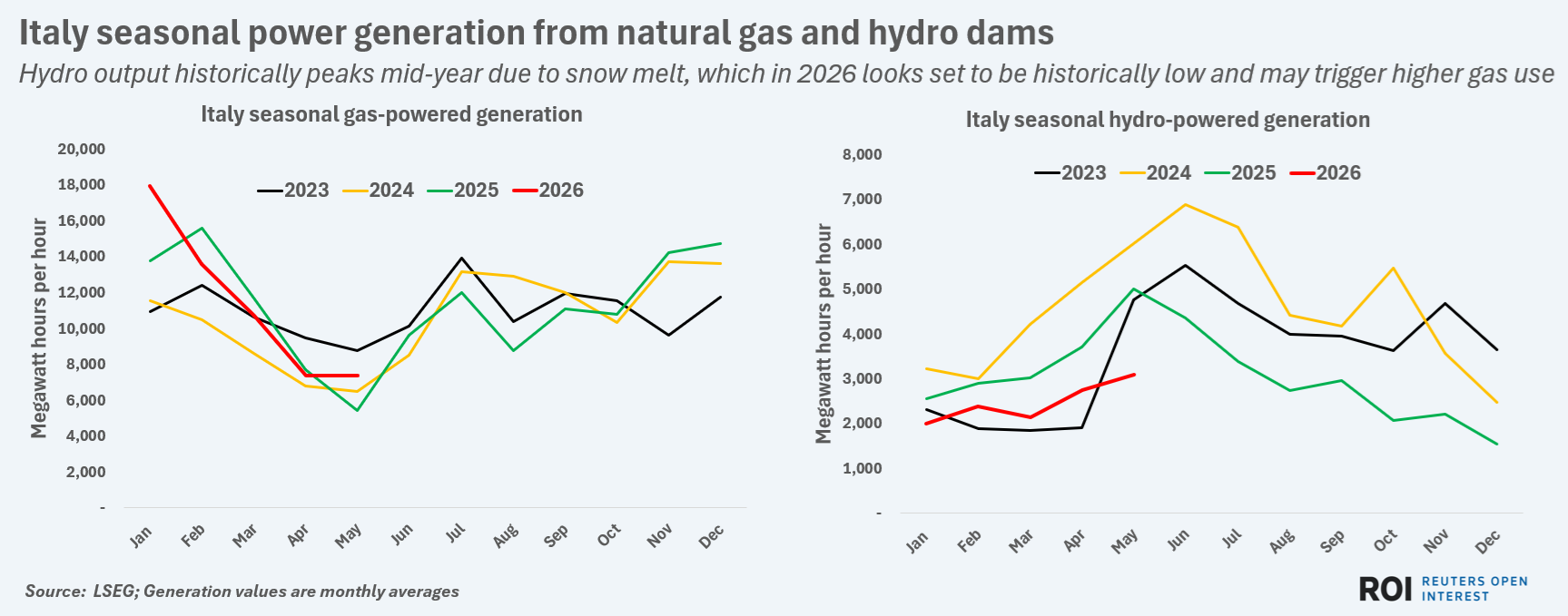
What's more, due to the light snowpack this past winter combined with a warm spring that accelerated snowmelt, Italy's hydropower peak has likely already passed.
That means that any upcoming jumps in national power needs - such as for greater use of air conditioners during any heatwaves - will be almost entirely reliant on natural gas plants, which form the backbone of the country's electricity system.
As Europe's gas storage operators tend to replenish stocks over the summer when regional gas use is usually at its lowest, the prospect of Italy increasing gas burn rates over that same period may complicate restocking efforts by potentially tightening supplies and raising prices.
But with hydro dam generation levels well below normal, Italy and other southern European power systems may have little choice but to burn more gas going forward, even as other parts of Europe look to steer more gas into storage tanks.
FROM FIRST TO LAST? In an ironic twist to Europe's gas storage saga, Italy is currently a frontrunner in terms of replenishing gas tanks following steep depletions over the past winter.
Italy's gas storage network is currently around 61% full, according to LSEG, which compares to less than half full near the end of April when the country's tanks were at their lowest in years.
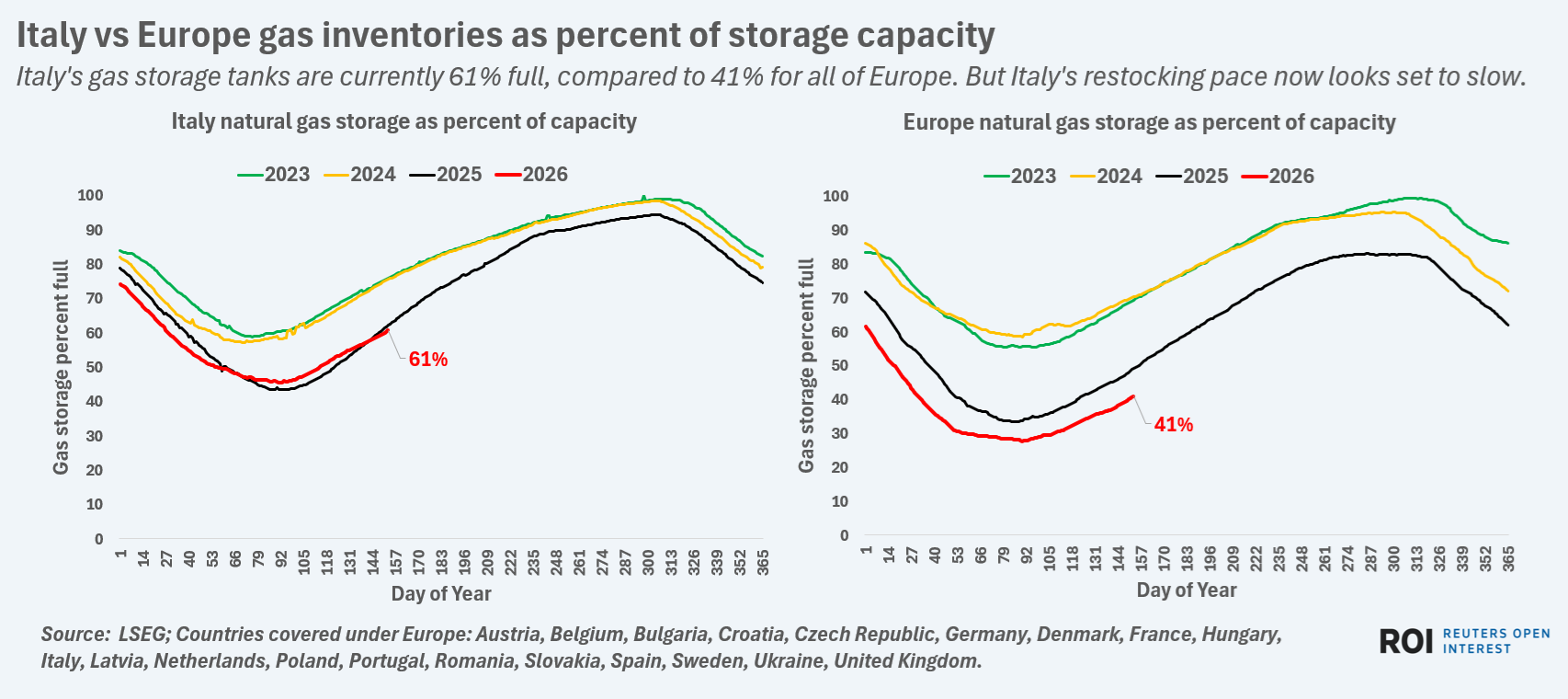
In contrast, gas storage levels for Europe as a whole are only around 41% full, which is by far the lowest in several years and means regional gas tank operators must accelerate restocking efforts if inventories are to be full by winter.
Yet Italy's low hydro levels may mean power firms have little choice but to increase gas consumption and slow gas storage replenishment rates from now on.
Italy's power output from hydro dams has averaged 2,472 megawatt hours per hour (MWh/h) from January through May, according to data from LSEG.
That is down 28% from the same months in 2025, and is the lowest for that time span since 2022.
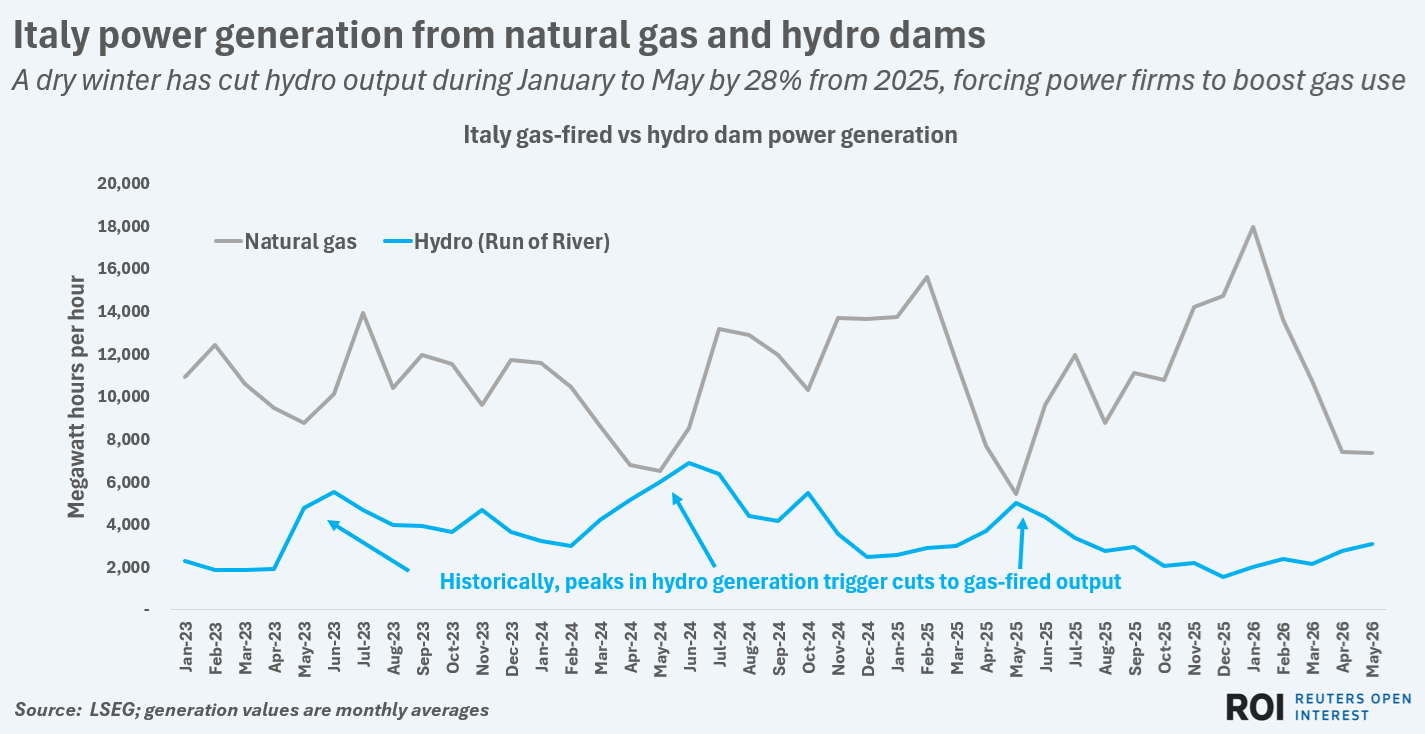
To compensate for consistently weak hydro production, Italy's power firms have increased average gas-fired power generation during January through May by around 5.2% from 2025 to around 11,400 MWh/h.
More significantly, the gas generation rate in May averaged 7,373 MWh/h, which is 35% above the rate seen during the same month in 2025, when average generation from Italy's hydro dams was around 38% above this year's May generation total.
BIGGER IMPACT. The flip from hydro to gas means more than just altering the power mix for Italy's generators. It also materially impacts system generation costs.
Italy's network of hydroelectric plants across northern parts of the country can cheaply generate large volumes of dispatchable power, which frees up gas to inject into storage while lowering overall power production costs.
But when hydro dam production is impeded, Italy's power producers must turn to more expensive natural gas to plug any generation gaps, thereby raising system costs.
And the impact extends across Europe.
Periods of robust hydro production allow Italy to act as a net contributor to Europe's gas rebuilding cycle, as the country holds close to 20% of the region's total gas storage capacity, according to data from Gas Infrastructure Europe (GIE).
But when hydro production disappoints, the dynamic flips. Gas burn rises, storage injections slow, and Italy's role shifts from buffer to constraint.
What's more, the challenge is no longer cyclical. Italy's hydro output is becoming structurally less reliable.
Warmer winters are eroding Alpine snowpack, reducing the volume of water available during the key spring melt season. At the same time, hotter summers increase evaporation rates and strain reservoir levels.
Rainfall patterns are also growing more erratic, making it harder to capture and store water efficiently.
The result is a system that delivers lower and more volatile output across the year.
Hydropower, once a dependable backbone of Italy's power mix, is now a less predictable contributor. That unpredictability matters most during the spring and summer months - precisely when Europe is trying to rebuild gas stocks.
This means trackers of Europe's gas stockpiles must also keep tabs on Italy's reservoir output, which currently suggests that regional gas use may now climb just as storage injections are due to hit their peak growth period for the year.
The opinions expressed here are those of Gavin Maguire, a columnist for Reuters.
Related News
Related News

- U.S. natgas prices hit 20-week high on LNG flows, heat outlook
- Baker Hughes’ fuel flexible NovaLT™ 16 gas turbine certified by RINA for marine propulsion
- Commonwealth LNG FID attracts global syndicate of leading banks
- Dozens injured, 18 missing after blast during restart at giant Qatar LNG site
- U.S. natgas futures rise as hotter weather boosts demand, some spot prices negative

Comments