

Turkey's hydro surge helps extend Europe's gas demand slump
Turkey's power producers have gained a powerful new advantage from an unlikely source: water.
A surge in hydroelectric output has allowed utilities to slash natural gas use during January to May by the most in over seven years, sharply reducing power-sector emissions while easing the country's dependence on imported fuel.
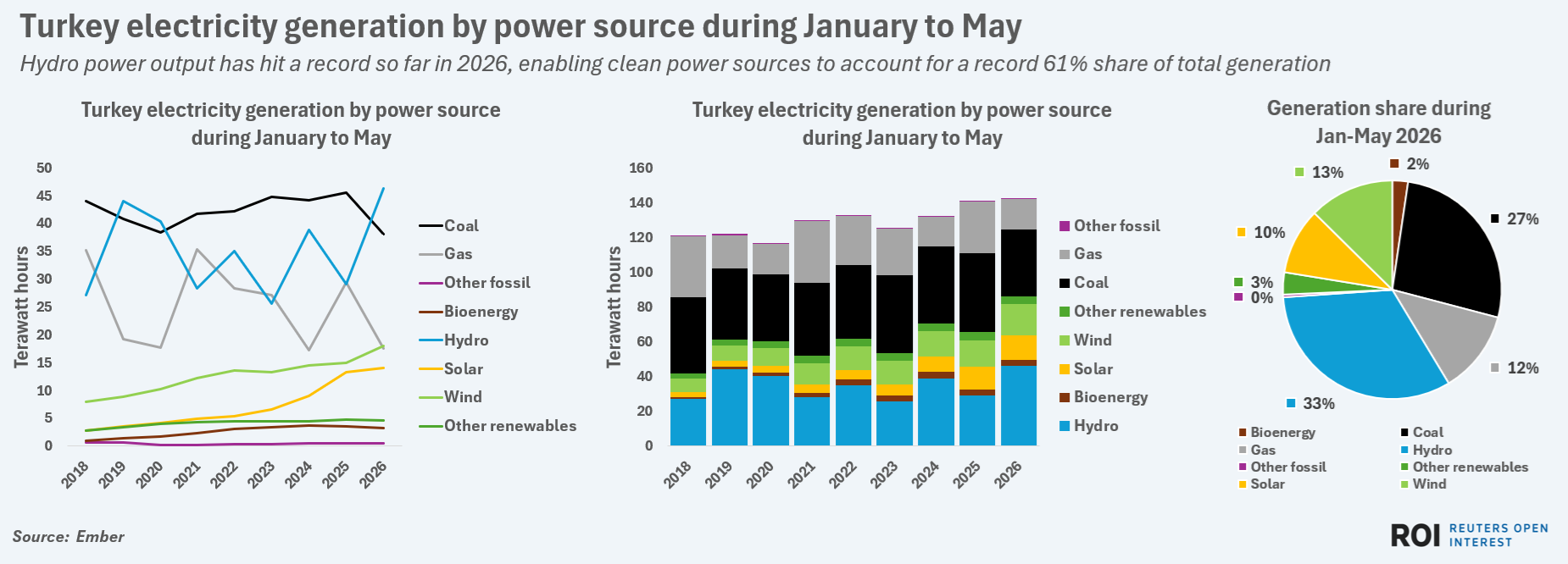
The shift has been dramatic. Between January and May, hydro output jumped nearly 60% from a year earlier while gas-fired generation plunged more than 40%, according to data from think tank Ember.
Alongside record solar and wind output, the surge in hydro generation enabled clean energy sources to account for more than 60% of Turkey's electricity mix for the first time, marking a key energy transition milestone for the fast-growing economy.
And the repercussions extend far beyond Turkey's borders.
As Europe's fourth-largest gas-consuming nation, according to the Energy Institute, Turkey's pullback in gas demand is helping reinforce a broader regional trend of weaker gas use and stronger renewable generation.
Turkey's lower gas use has also allowed the country to inject more gas into storage facilities instead of burning it in power plants, which is helping to limit Europe's broader gas inventory drawdown so far in 2026.
Hydro takes center stage. The dominant story in Turkey's power system this year has been the resurgence of hydropower.
Hydro generation totalled 46.33 terawatt hours (TWh) during January–May, the highest on record for that period and up from 29.03 TWh during the same period in 2025, a gain of nearly 60% or 17.3 TWh.
That increase alone was nearly as large as Turkey's total gas-fired electricity generation during January to May (17.48 TWh), and underscores the substantial impact that the swell in hydro supplies has had across Turkey's power system.
Hydro output exceeded generation from both coal and gas during the opening five months of the year, making water the single largest source of power in Turkey's generation mix.
Hydro's share of total utility-supplied electricity climbed to 33.2% from 20.8% a year earlier, and the highest since January to May in 2020.
Strong reservoir levels and favorable weather conditions allowed dam operators to maximize production just as electricity demand continued to edge higher.
Total electricity generation during January to May rose to a record 142.44 TWh from 140.88 TWh a year earlier, meaning Turkey generated more power overall while simultaneously lowering fossil-fuel use.
Gas setback. The principal casualty of the hydro boom has been natural gas.
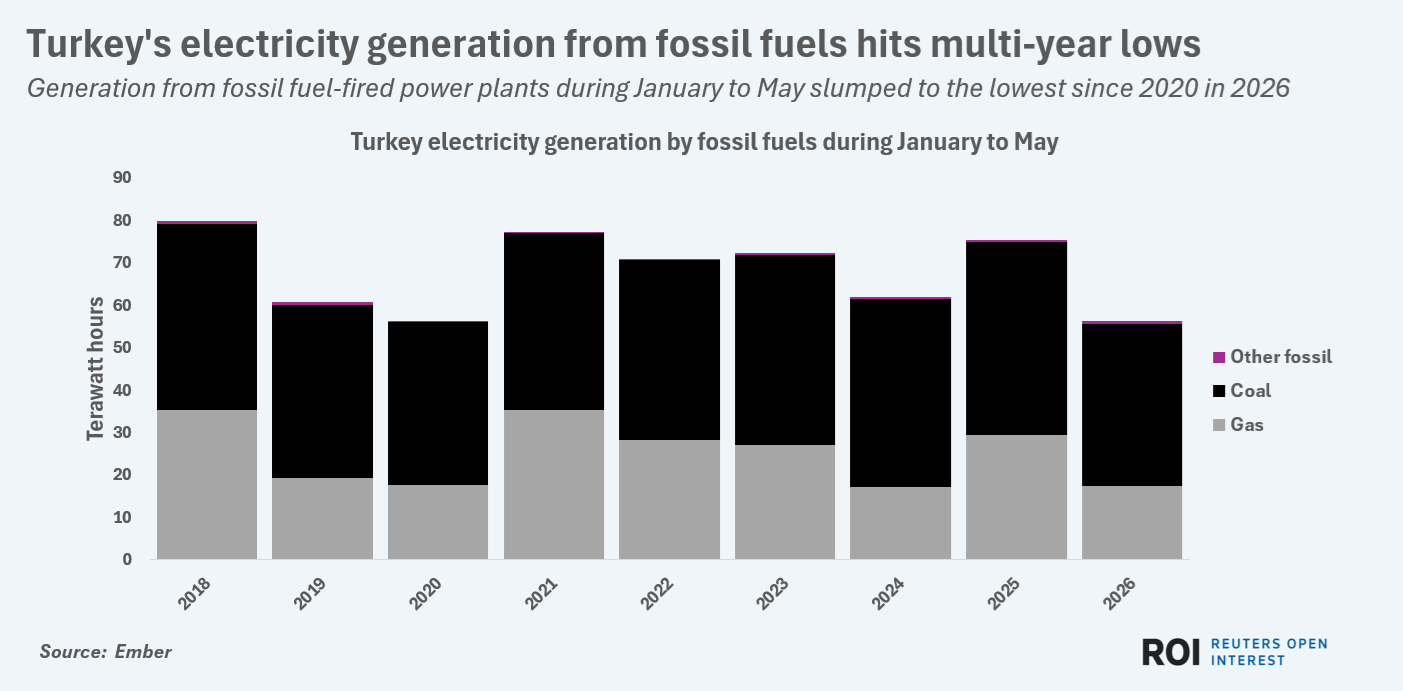
Gas-fired generation fell to just 17.48 TWh during January–May from 29.42 TWh a year earlier, a decline of 40.6%. Gas's share of total generation dropped from 20.7% to 11.9% — an all-time low for that period.
In absolute terms, gas generation fell by nearly 12 TWh from the year before, the largest year-to-date decline in at least seven years based on Ember data.
The decline was especially pronounced during spring, when hydro production surged.
Gas-fired generation averaged roughly 2 TWh a month from March through May versus more than 4 TWh during several months in the same period last year.
Coal generators were also squeezed.
Coal-fired output fell 16.1% year-on-year to 38.14 TWh, reducing coal's share of generation from 32.2% to 26.4% and the lowest in more than a decade.
Clean power milestone. Hydro has not been acting alone.
Turkey's wind generation climbed to 17.97 TWh during January-May, up from 14.95 TWh a year earlier, while solar generation increased to 13.98 TWh from 13.31 TWh.
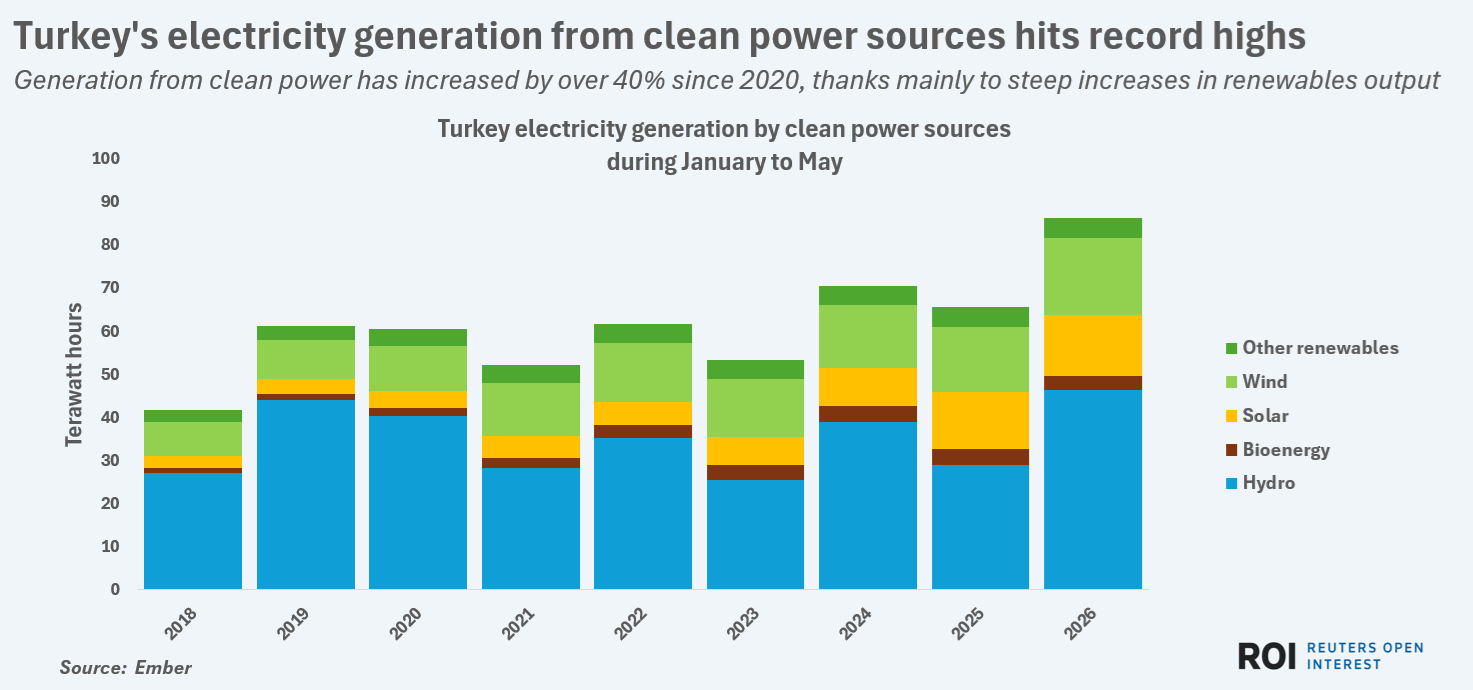
Together, hydro, wind and solar pushed clean electricity production to 86.25 TWh, up from 65.52 TWh a year earlier. Clean sources supplied 61.2% of all electricity, compared with 46.8% during the same period in 2025.
Fossil-fuel generation consequently fell by more than 25%, dropping to 56.19 TWh from 75.36 TWh.
The environmental impact of the steep cuts to fossil-fuel generation has been substantial. Power-sector emissions from the burning of fossil fuels fell to 47.91 million metric tons of CO2 equivalent from 61.01 million tons a year earlier, a drop of more than 21%.
Storage boost. Lower gas burn has created another benefit: more fuel available for storage.
Instead of consuming large volumes of imported gas in power plants, Turkey has been able to channel additional supplies into underground storage facilities.
Year-to-date storage injections have reportedly run around 18% above year-earlier levels, according to LSEG, a notable development at a time when Europe has been working to replenish inventories after a stronger withdrawal season.
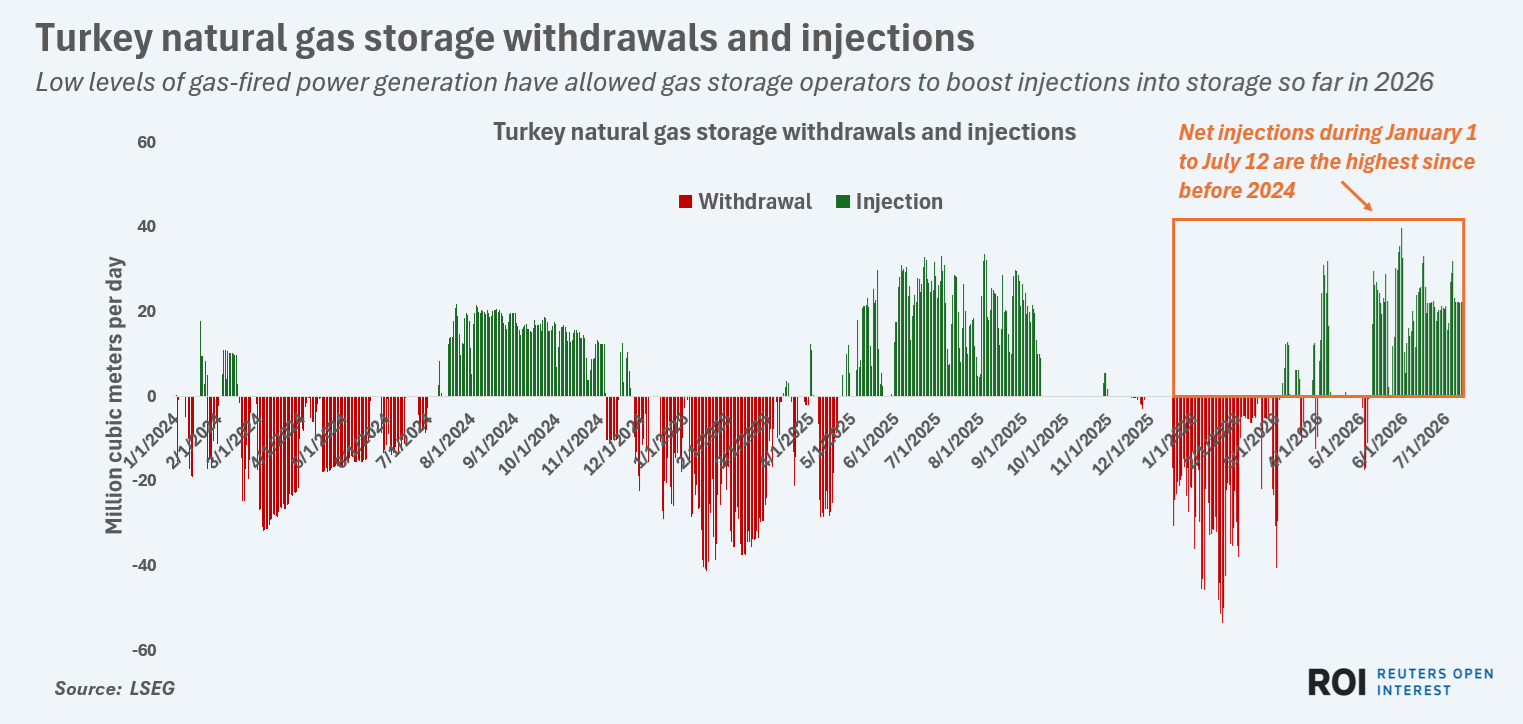
By storing more gas domestically, Turkey has reduced pressure on the wider European gas system and helped limit inventory drawdowns across the region.
That may prove almost as important as the decline in power-sector gas use itself.
Turkey's position as a major transit and consumption market means shifts in its gas balance increasingly affect regional supply dynamics.
Broader trend. Turkey's experience also fits a wider story unfolding across Europe.
Across the region, renewables continue to erode gas's role in electricity generation whenever weather conditions cooperate.
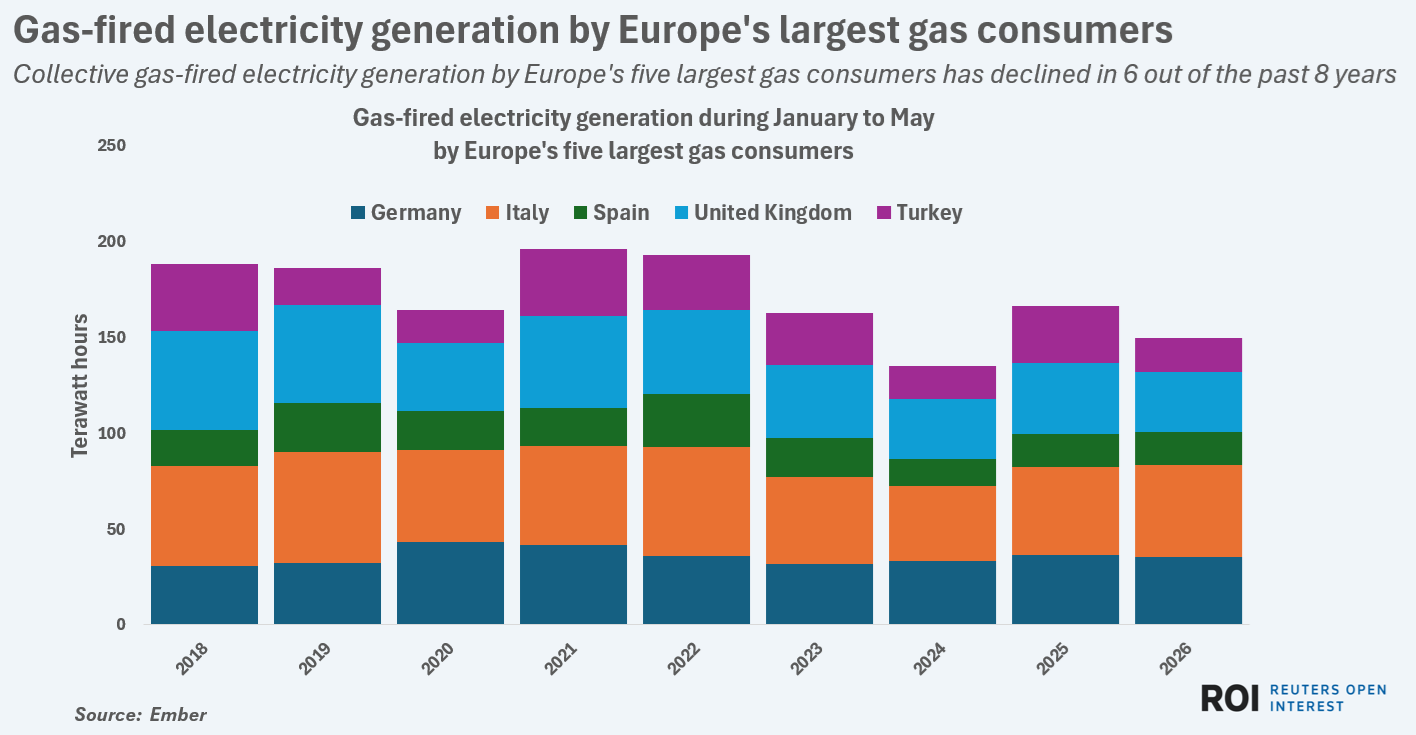
European policymakers have spent years trying to cut exposure to volatile imported gas through greater renewable deployment, efficiency gains and electrification.
Europe's gas consumption remains well below pre-crisis levels despite periodic rebounds tied to weather and power-sector demand.
Turkey's hydro-led power transformation represents one of the clearest examples of that trend in 2026.
Unlike episodes where gas demand falls because economic activity weakens, Turkey's reduction has occurred while total electricity generation has increased.
That suggests fuel switching rather than demand destruction.
And for a continent still trying to reduce its reliance on imported gas, that may be the most encouraging signal of all.
The opinions expressed here are those of Gavin Maguire, a columnist for Reuters.
Related News
Related News

- U.S. natgas prices hit 20-week high on LNG flows, heat outlook
- Cheniere signs deal with Bechtel to expand U.S. LNG export capacity
- Baker Hughes’ fuel flexible NovaLT™ 16 gas turbine certified by RINA for marine propulsion
- Commonwealth LNG FID attracts global syndicate of leading banks
- Dozens injured, 18 missing after blast during restart at giant Qatar LNG site

Comments