

Updates on buildup of Germany LNG import terminals
Germany has been putting import terminals for liquefied natural gas (LNG) into operation as part of its efforts to replace piped Russian gas following Moscow's invasion of Ukraine in 2022.
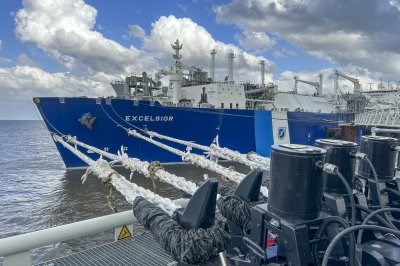
The Brunsbuettel terminal received its floating storage regasification unit (FSRU), the Hoegh Gannet, back on November 24 after upgrades, and Wilhelmshaven 2 has restarted its FSRU Excelsior ready for the coming winter months, state-appointed terminal company Deutsche Energy Terminal (DET) said.
DET, which is in charge of three terminal locations, has said it will rerun auctions for LNG landing capacity at Wilhelmshaven 1 and 2 in December, having so far failed to place a variety of slots. It has fed 59 terawatt hours into German grids so far this year.
Here are the details of developments at the sites:
Mukran. The terminal on Ruegen island in the Baltic Sea operated by private firm Deutsche ReGas supplies onshore grids with LNG from pipeline firm Gascade's OAL link, in cooperation with Norway's Hoegh Evi's FSRU Neptune.
It wants to restart a second FSRU eventually and restore full capacity of 13.5 Bm3 by 2027.
ReGas has launched a bidding round to expand Mukran's capacity by offering an additional 5 Bm3y from 2027 to 2043.
In September, it signed long-term agreements with chemicals producer BASF and Norwegian incumbent Equinor for non-specified regas capacity. The company said it regasified 8.35 TWh of LNG in October and November, holding first place ahead of each of the other three working LNG terminals.
Lubmin. ReGas and Hoegh plan to develop the Baltic Sea port, a forerunner of Mukran, into a green ammonia and hydrogen production and import terminal, which Gascade will link up with customers.
Wilhelmshaven. Utility Uniper launched Germany's first FSRU operation, Wilhelmshaven 1, on the North Sea in 2022.
Uniper plans to add a land-based ammonia import reception terminal and cracker in the second half of this decade to make green hydrogen, and build a 200-MW electrolyzer to be fed with local wind power.
DET officially started commercial operations at Wilhelmshaven 2 on August 29 via the Excelerate Energy-operated FSRU Excelsior. Maintenance also took place in October.
In auctions on November 25–26, DET failed to place some available regasification slots in 2025, 2026 and 2027 with gas market players, and will repeat them on December 9 and 10.
Stade. DET has agreed with the Hanseatic Energy Hub to take on the job of erecting an FSRU superstructure at the Elbe River onshore terminal.
DET said it would start on the inspection, planning and execution of the job, but added that the terminal would not be ready to go into operation before the second quarter of 2026.
The FSRU Energos Force would return to the site, where Uniper and sector peer EnBW will be the main customers. Prior to the latest developments, DET and HEH had temporarily cancelled contracts with each other over unresolved disputes related to construction schedules and payments.
HEH plans to start a shore-based terminal for LNG, bio-LNG and synthetic natural gas at Stade in 2027.
Brunsbuettel. The Hoegh Gannet was removed temporarily in September for upgrades. These were completed and the ship returned on November 24 to the North Sea port.
It went into operation in 2023 in Brunsbuettel, initially chartered by the trading arm of utility RWE, before being handed over to DET.
It is the forerunner of a land-based LNG facility, cleared to receive €40 MM ($46.4 MM) of state support.
This could start operations at the end of 2026, when a newly inaugurated, adjacent ammonia terminal could also start up.
($1 = €0.8618)
Related News
Related News

- Mitsubishi Heavy Industries Compressor acquires Swiss rotating equipment maintenance company AST Turbo AG
- RWE strengthens partnerships with ADNOC and Masdar to enhance energy security in Germany and Europe
- TotalEnergies and Mozambique announce the full restart of the $20-B Mozambique LNG project
- Cook Inlet LNG advances FSRU project in Alaska (U.S.)
- Qatar’s Ras Laffan LNG hub hit by missile attack, ‘extensive damage’ reported

Comments