

Europe gas markets escape hectic LNG summer storage race
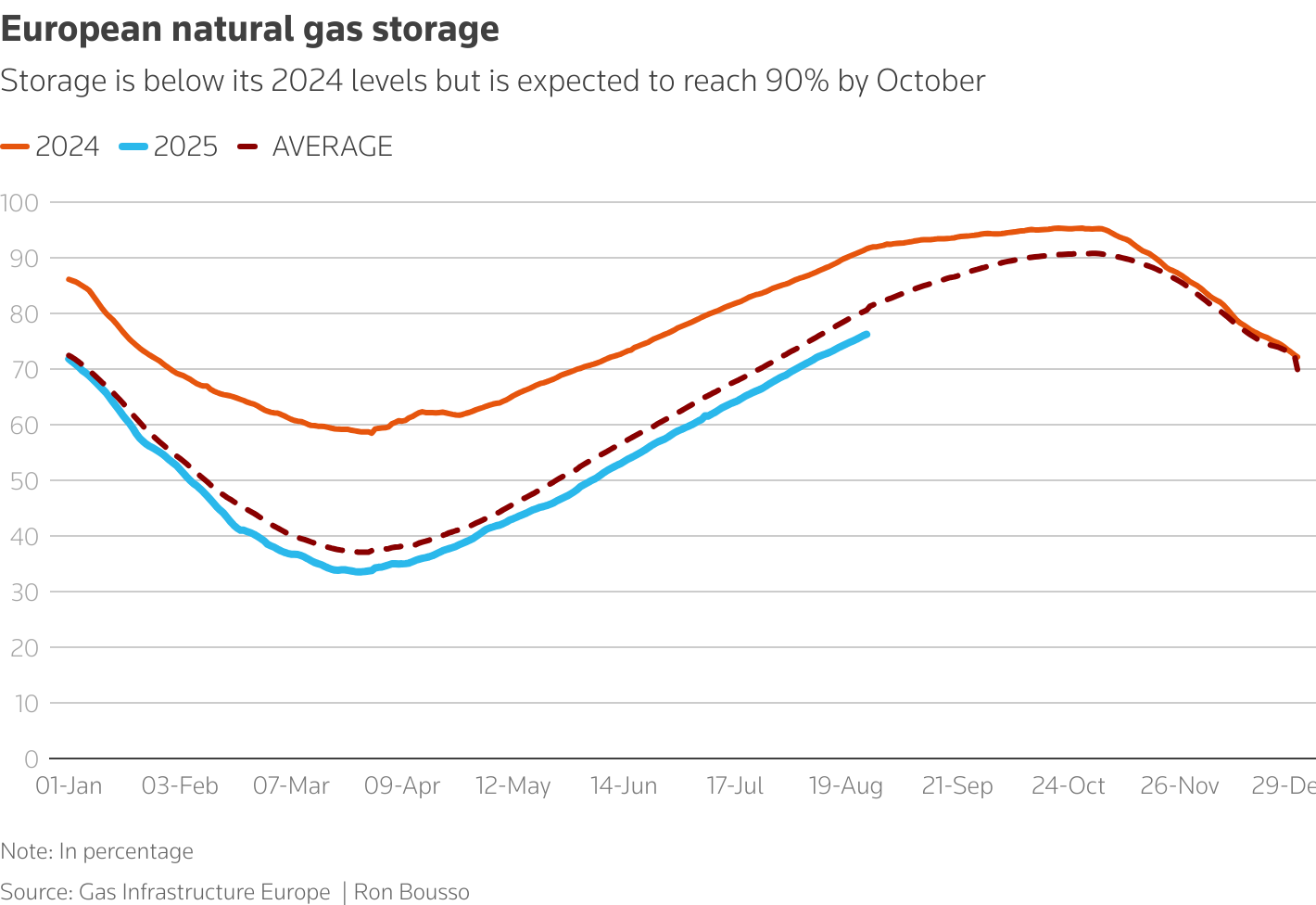
- European storage is at 76% of capacity, likely to reach 90% by October
- Easing LNG demand in Asia to increase flows to Europe
- LNG oversupply to grow sharply by 2030
European gas traders have faced a stressful race against the clock in recent summers as they have scrambled to refill depleted gas storage facilities ahead of winter.
But with demand in Asian markets sagging, Europe can expect a surge of liquefied natural gas (LNG) imports over the coming months, giving the continent’s traders and governments a lot more breathing room.
Ensuring that European gas supplies were at near-maximum levels before cold weather sets in was once a relatively niche concern, but it became a political imperative after the region sharply reduced pipeline gas imports from Russia following its invasion of Ukraine in 2022.
In that year, the EU introduced rules, which have since been eased (learn more), requiring storage to reach 90% capacity by November each year, measures that created price distortions, disrupted supply and led to a hectic scramble for supplies.
No such rush is expected this year.
True, European storage is only at 76% of capacity, or roughly 85 Bm3, as of August 25, according to Gas Infrastructure Europe (GIE) data. That’s down from 92% a year ago and the 10-yr average of 80.5%.
The region saw LNG imports drop from a yearly peak of around 11 MM tonnes (t) in March to an expected 7.4 MMt in August, according to data from analytics firm Kpler, due to weaker regional demand as well as stronger buying from Asia.
That is largely a mirror image of Asian LNG imports, which spiked in August at 26 MMt compared with an annual low of 21 MMt in February.
But Asian buying is expected to slow significantly during the rest of 2025 due to high inventories in China and other importing nations, freeing up LNG volumes for Europe.
This rise in LNG imports is expected to help offset the reduction in regional supplies resulting from seasonal maintenance work being completed at several Norwegian gas fields through late September.
So, storage is still set to easily reach 90% by the start of the heating season in October – no scrambling required.
Supply boom. In what is likely welcome news to European governments, the summer LNG storage refilling frenzy is unlikely to return for at least the next five years.
Global LNG capacity is set to increase from 550 Bm3 last year to 590 Bm3 this year and to 649 Bm3 in 2026, before reaching 890 Bm3 in 2030, according to LSEG estimates.
The growth has been driven primarily by the United States, where exports in the first seven months of 2025 have surged by 22% from a year earlier to 83 Bm3, according to LSEG data. This reflects the commencement of operations at several large Gulf Coast liquefaction facilities including Venture Global's Plaquemines LNG.
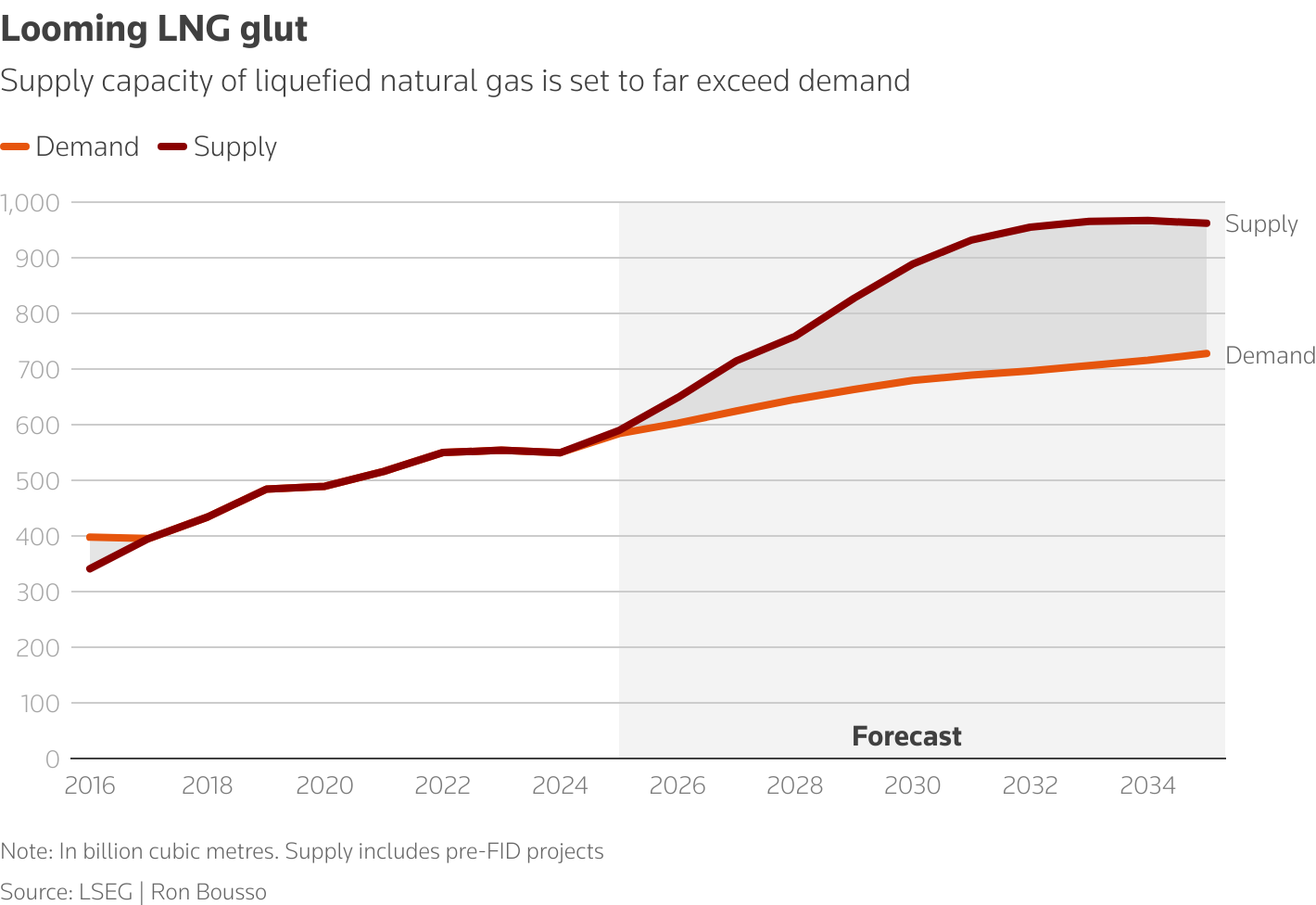
While supply is set to largely equal demand this year, the market is expected to see a glut of nearly 50 Bm3 in 2026 and as much as 200 Bm3 in 2030, based on current projections.
Clearly, such a large supply-demand disparity will lead to curtailments in LNG production, with the United States likely to make the first cuts, given that producers there are more price-sensitive than in other regions.
Consumer impact. European gas prices certainly could fluctuate significantly during the coming winters based on the weather. For example, last winter was significantly colder than the previous two, leading to a large draw in inventories, which put upward pressure on prices.
For now, though, the burgeoning oversupply in the market appears to be good news for consumers, who are set to benefit from several years of relatively low LNG prices, which, in turn, could help stimulate industrial activity on the continent.
European leaders may also be able to breathe a sigh of relief, as this market dynamic could enable them to successfully pursue their two-pronged goal of reducing reliance on Russian gas supplies while also lowering their voters’ energy bills.
The opinions expressed here are those of Ron Bousso, a columnist for Reuters.
Related News
Related News

- RWE strengthens partnerships with ADNOC and Masdar to enhance energy security in Germany and Europe
- Mitsubishi Heavy Industries Compressor acquires Swiss rotating equipment maintenance company AST Turbo AG
- TotalEnergies and Mozambique announce the full restart of the $20-B Mozambique LNG project
- Venture Global wins LNG arbitration case brought by Spain's Repsol
- KBR awarded FEED for Coastal Bend LNG project

Comments