

Digital Exclusive: Turbomachinery: The backbone of cryogenic gas processing
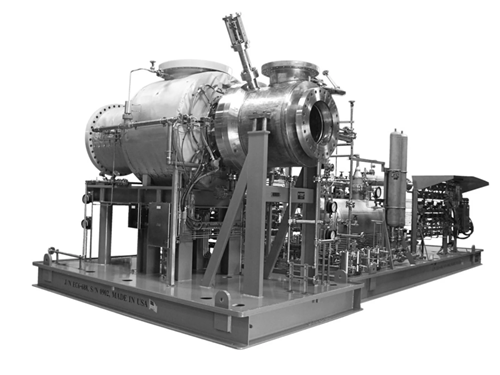
The radial inflow turbine (an expander) was introduced into the air separation industry in the late 1930s (in Germany), and in 1962, the first turboexpander-compressor for cryogenic natural gas processing was installed (in the U.S.). Thereafter, the technology’s high-thermal efficiency, flexibility and operational robustness quickly established the cryogenic expander plant as an industry standard. In the intervening decades, turboexpander-compressors have benefited from iterative advancements in software, engineering design software and material science. These have manifested themselves in a number of technological improvements, such as advancements in aerodynamic design, higher rotating speeds and enhanced system reliability. That said, fundamentally, turboexpander-compressor integration into cryogenic natural gas processing has generally remained the same.
This article shows how turboexpander-compressors became the backbone of cryogenic processing, and how they are directly linked to a plant’s efficiency and reliability. It explores the design and flexibility of modern expander-compressor machines.
Additionally, using the example of a natural gas liquids (NGL) recovery plant in North Dakota (U.S.), it discusses the aerodynamic design concept of integrally geared compressors (IGCs) applied in propane refrigeration cycles.
Turboexpander-compressors and cryogenic processing. A radial inflow turbine (conventionally called an expander) is a simple rotating machine with an overhanging wheel. Its success in cryogenic natural gas plants comes from three central characteristics:
- Highly efficient near isentropic expansion, allowing for effective separation of natural gas heavy components
- Energy recovery through recompression using a directly coupled centrifugal stage
- Flexible operation with variable inlet guide vanes (vIGVs) to optimize efficiency over a wide range of natural gas process conditions and provide gas plant process control.
The integration of an expander-compressor into a cryogenic natural gas plant is relatively straight forward: natural gas flows into a warm separator after front-end processing of cleaning, stabilization, sweetening, dehydration and cooling. Natural gas in saturated conditions flows into the expander and chills down via near isentropic expansion, before flowing into a cold separator. Heavier hydrocarbon drops out of the natural gas stream before flowing through heat exchangers and into the compressor end of the expander. An expander extracts energy from the process fluid, which needs to be connected to a braking device, such as a generator, a hydraulic brake or compressor.
Expander-compressors and stability. The expander-compressor shaft is a rigid shaft supported by radial and thrust bearings. The expander and compressor wheels hang over either side of the shaft, giving the rotor a rigid body design. This design allows for no bending critical speed in the range of its operating speed or up to 115% of its maximum continuous speed. When designed with vIGVs, the performance curve of an expander is relatively flat around the design point, without significant loss of efficiency during off-design operation. This is an ideal feature for a natural gas processing plant. An expander-compressor in a typical cryogenic natural gas processing plant has an axially balanced load. These features create an ideal situation for active magnetic bearings, which have become the petrochemical industry standard, the offshore best solution, as well as for many mega-scale gas processing and LNG pre-treatment units.
For the stable operation of a natural gas processing plant and the optimal performance of an expander-compressor, two valves are very important: the expander bypass valve, or Joule Thompson (JT) valve, and the compressor recirculating valve, or anti-surge valve. The JT bypass valve provides process stability prior to startup, ensuring a smooth startup of the expander-compressor. The expander IGV actuator and bypass valve typically operate on a signal-based split-range configuration. The compressor recycle valve, or surge control valve, in contrast, protects the compressor against surge conditions, providing a smooth startup and safe shutdown of the expander-compressor.
Integrally geared compressors in gas processing. While expanders are used directly in the process stream for refrigeration, integrally geared compressors are used in the refrigeration loop. IGCs are dynamic radial centrifugal compressors, and they are 100% oil-free by design principle. This increases reliability, and it eliminates contamination risk to the refrigeration process loop. Integrally geared technology is based on a central (integral) gearbox, inside of which is the main bull gear, which drives several separate high-speed pinions. These pinions supply rotational power to compression stages (impellers) that are paired sequentially into stage groups of two by mounting two impellers at each end of the pinion shaft.
The inherent requirement of any dynamic compression is to match the impeller and stage geometry with the optimized speed, resulting in optimal efficiency and head development. The optimal speed for each pair of compression stages is determined based on the aerodynamic characteristics of those equipment parts that are tasked with compressing the gas: the impeller, the diffuser and the volute. This speed is then used to assign the gear ratio between the bull gear and the corresponding pinion for its stage group. The improved aerodynamics that IGCs can obtain at each stage (impeller, diffuser, and volute) translate into higher per-stage efficiency and pressure ratios. As a result, fewer compression stages are necessary to reach a target outlet pressure.
The technology’s versality is key: because each impeller in an IGC has its own guide vanes, diffuser, volutes, seals and bearings, it acts as an individual compression stage and compressor itself. This inherent design feature allows simple accommodation of any incoming side streams (addition of the flow in the subsequent compression stages) or outgoing streams (removal of the flow in the subsequent compression stages). This not only allows changing or different mole weights for the individual subsequent compression stages, but it also allows for easy accommodation of different gases from separate process streams, plus intercooling between each compression stage on the same gear box or compressor.
Regarding the flexibility in this process (accommodating a broad operating range at constant discharge pressure), IGCs can be designed with vIGVs, which allow up to 25%-30% turndown; and variable diffuser guide vanes (vDGVs), with up to 50% turndown; or through a combination of both, with up to 70% turndown. Generally, guide vanes can maintain the required (and subsequently designed) discharge pressure, therefore, handing operators the flexibility to cope with varying mole weights and head requirements. vDGVs in particular can help with startup during high settle-out conditions along with varying mole weight.
IGCs at an NGL recovery plant in North Dakota (U.S.). An NGL recovery plant in North Dakota highlights the success of the aerodynamic design concept of IGCs applied in propane/propylene refrigeration cycles. The IGCs were deployed in a mechanical refrigeration cycle using 95%-98.5% commercial-grade propane, with the rest being heavy hydrocarbons, or HD5 or higher-grade propane. Similar to many NGL recovery (gas processing) plants, this installation also faces variable and, at times, uncertain process conditions. Operators of gas processing plants typically face challenges with the mode of operation (ethane rejection or ethane recovery) and feed gas uncertainty (rich gas or lean gas). Other challenges may be colder or warmer ambient temperatures, especially when an air-cooled condenser is used. These factors also place significant requirements on the compressor technology used, which results in overall refrigeration cycle efficiency.
There are several proprietary NGL recovery processes on the market, and the selection of the most appropriate requires a balance between the initial capital expenditure and long-term efficiency savings. The rather narrow range of compression requirements allows for the optimization of the compressor’s aerodynamic design, achieved by optimally designing impeller blade geometry and by selecting the corresponding optimal speed. Integrally geared technology tends to accommodate this very well, with the compressor’s resulting polytropic efficiency being in a range between 80%-85%.
Propane is a heavy mole weight gas, and this has a significant effect on both the impeller and stage design, especially at colder temperatures of below -20°F (-29°C). The inherently higher speeds at which IGCs run results in higher Mach numbers, which effects the compressor’s operating range, performance and efficiency. An optimal Mach number and flow coefficient result in best compression efficiencies and operating ranges. The machine designer, Atlas Copco Gas and Process, in consultation with the customer, focused on selecting the optimal head for the impeller to avoid a higher Mach number. This directly affected the propane refrigeration cycle design and the staging split, meaning setting up economizer pressure in case of a two- or three-stage refrigeration loop.
Typically, 80%-82% polytropic efficiency is desired and can be delivered for three impeller compressor configurations, with the chiller operating at -30°F (-34°C) or lower. When the chiller is operated at -30°F (-34°C) or warmer and the compressor is configured for three-to-four impellers, around 85% polytropic efficiency can be achieved.
Usually, when the condenser is fixed in the refrigeration loop, the colder chiller has an economizer operating at a lower pressure, and the warmer chiller has an economizer operating at higher pressure. Analysis showed that the warmer the condensing temperature, the lower the coefficient of performance (COP). Therefore, selecting the optimal economizer pressure based on the best compressor efficiency is key to achieving overall refrigeration cycle efficiency. The authors’ research showed that an efficiency gain of about 10% can be achieved with an IGC compared to the other positive displacement compression technologies available for this application.
Takeaway. This article has shown that both the inherent characteristics and the specific aerodynamic design features of IGCs enable operators to achieve optimum efficiency in propane/propylene refrigeration cycles. The primary reason is that integral gearing can match the impeller geometry to the optimum speed, which results in higher compression efficiency. The fundamentals of the technology and processes are largely unchanged, even after many decades employed cryogenic natural gas processing, and they remain the backbone of cryogenic gas processing.
For more information, visit https://www.atlascopco.com/gas-and-process/en.
Related News
Related News

- Mitsubishi Heavy Industries Compressor acquires Swiss rotating equipment maintenance company AST Turbo AG
- RWE strengthens partnerships with ADNOC and Masdar to enhance energy security in Germany and Europe
- TotalEnergies and Mozambique announce the full restart of the $20-B Mozambique LNG project
- Cook Inlet LNG advances FSRU project in Alaska (U.S.)
- Qatar’s Ras Laffan LNG hub hit by missile attack, ‘extensive damage’ reported

Comments